
Reviewed · COLCA CANYON AND AREQUIPA TOURS
Sillar Half Day Route in Arequipa
White stone tells Arequipa’s story. I like the volcano viewpoint for its clear look at Misti, Chachani, and Pichu Pichu, and I like the chance to see sillar extraction still practiced by hand. The main drawback is time: pickup delays can leave you rushing through the quarry and Culebrillas.
This four to five-hour outing costs $17 per person and begins and ends near the center of Arequipa. You’ll ride in an air-conditioned vehicle, walk through two quarry areas, and learn how the pale volcanic stone shaped the city’s identity.
I’d choose this tour if you want a low-cost introduction to Arequipa’s stonework without giving up most of your day. You should arrive ready for uneven ground, a short steep climb, and a fairly brisk pace.
In This Review
- Key points to know before booking
- Why sillar matters in Arequipa
- The 9:00 AM start and the city pickup
- The volcano viewpoint and Arequipa’s volcanic setting
- Entering the main sillar quarries
- Culebrillas, pink walls, and faint petroglyphs
- How the timing affects the experience
- What the $17 price really includes
- Who should book this half-day route
- My verdict: a useful first look at Arequipa’s stone
- FAQ
- Where does the Sillar Half Day Route begin?
- Where does the tour end?
- How long does the tour last?
- What time does the tour depart?
- What is included in the price?
- Are snacks and drinks included?
- Is the tour suitable for everyone?
Key points to know before booking
- The three-volcano view: Stop for photographs of Misti, Chachani, and Pichu Pichu from a viewpoint outside the city.
- Sillar is still worked by hand: At the main quarry, you can see the human marks behind Arequipa’s famous pale buildings.
- Culebrillas adds ancient rock art: A roughly 20-minute walk leads through pink canyon walls and faint petroglyphs.
- The pace can feel tight: Pickup time and a short quarry visit may reduce time for looking around.
- Closed-toe shoes matter: Uneven paths and a steep exit at Culebrillas make sturdy footwear a smart choice.
- The price is friendly: At $17, the tour offers transport, a guide, and several distinct stops in half a day.
Why sillar matters in Arequipa
Arequipa is often called the White City, and sillar explains why. This pale volcanic rock appears throughout the city’s construction, giving churches and other buildings their light-colored appearance.
The tour helps you connect what you see in the historic center with the source of the material outside town. Instead of treating Arequipa’s architecture as a collection of attractive façades, you get to see the cliffs where the stone was cut and shaped.
That connection is the real value here. You begin near the historic center, then travel toward the quarries while the guide explains how volcanic rock was used in local construction. The subject is simple to understand, but seeing the raw material makes it more concrete.
You should keep your expectations realistic. This is not a long technical workshop in stone cutting. The experience gives you an introduction to the material, the quarry setting, and the traditional work. One thing you might not see in detail is the complete process of cutting a large block out of the mountain and shaping it into a finished piece.
More Colca Canyon trips:
- 2 day 1 night trek / Colca Canyon
★ 5.0 · 1,069 reviews - From Arequipa: Colca Canyon Full-Day Guided Tour with Meals
★ 4.5 · 982 reviews - Tour to the Salinas Lagoon and National Reserve in Arequipa
★ 4.5 · 548 reviews
The 9:00 AM start and the city pickup
The morning departure is scheduled for 9:00 AM from Templo de San Agustín on Calle Sucre, near Arequipa’s Plaza de Armas. The tour also ends at the same meeting point, or one block from the Plaza de Armas, which makes it easy to continue sightseeing afterward.
The vehicle is air-conditioned, a useful comfort when you are moving between the city and the open quarry areas. The group can include up to 18 people. That is small enough for a guide to address the group, though it is not a private outing.
Allow extra patience at the start. Pickup arrangements within a block or two of the main square can take longer than expected. If the vehicle spends close to an hour collecting people, the later stops may feel compressed. I would treat the advertised four to five hours as a full half-day, not as four uninterrupted hours at the quarries.
The tour operates in two daily blocks: 9:00 AM to 1:00 PM and 2:00 PM to 6:00 PM, Monday through Sunday, during the listed operating period. The morning option gives you the rest of the afternoon for Arequipa’s churches, museums, and central streets.
The volcano viewpoint and Arequipa’s volcanic setting
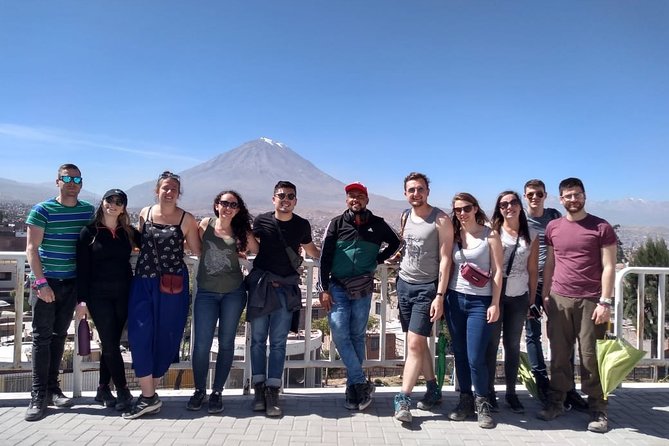
The first planned stop is a viewpoint where you can see three volcanoes around the city: Misti, Chachani, and Pichu Pichu. The stop lasts about 20 minutes and has no separate admission charge.
This is a short stop, but it earns its place. The view gives you geographic context before you reach the quarry. Arequipa is not simply a colonial city built with white stone. It is a city shaped by volcanic material and surrounded by major volcanic peaks.
Bring your camera, but also take a moment to identify the three peaks as the guide points them out. The stop is designed for panoramic photographs rather than a long walk or extended sightseeing. If the sky is clear, this may be one of the most memorable visual moments of the morning.
Since the tour does not promise a particular weather condition or visibility, the view can vary. Still, it is a worthwhile pause because it links the volcanic setting to the stone you will see later.
Entering the main sillar quarries
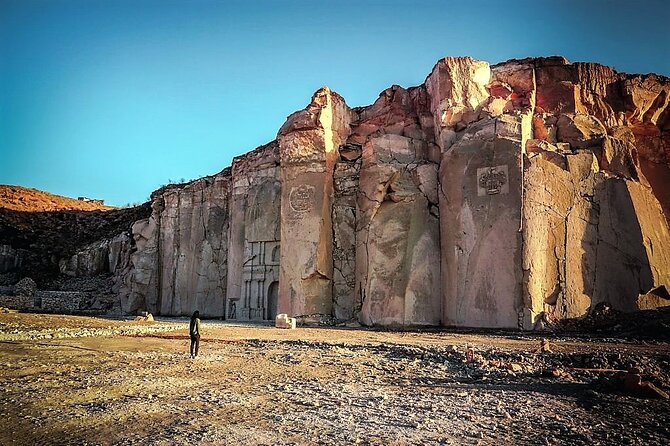
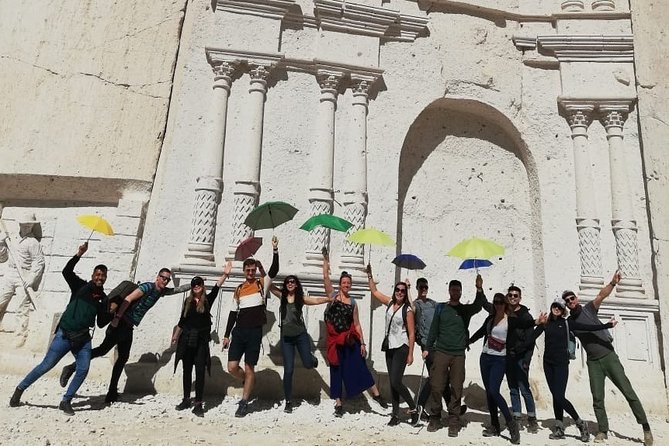
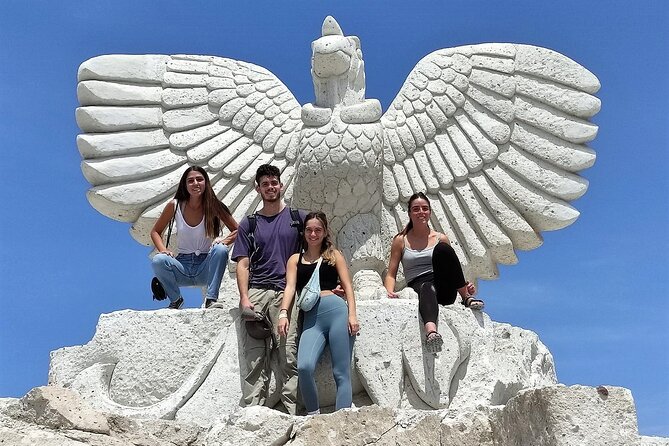
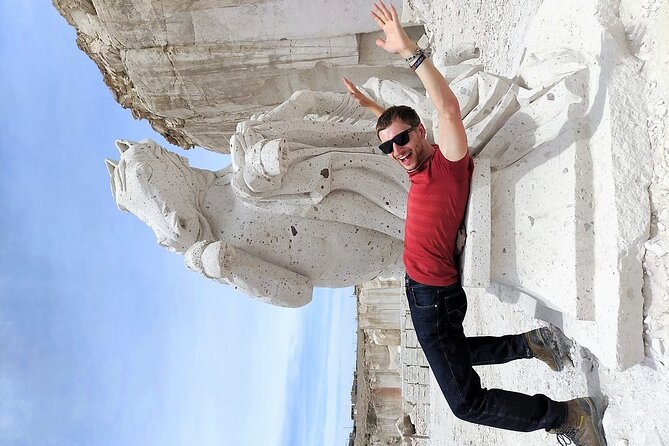
The main quarry visit is the heart of the outing. You enter the area where the pale stone was extracted and see large cliffs shaped by human labor. The guide explains the site, and you have time for photographs among the many sillar carvings and sculptures.
Those carvings give the quarry a more personal feel. You are not looking only at a raw industrial site. You’ll find decorative pieces and figures that make the material easier to understand and photograph.
The most useful part of the visit is the chance to watch and interact with people preserving the traditional extraction method. The technique reaches from the colonial period to the present, so the quarry connects the city’s older buildings with work that continues today.
Still, the timing deserves attention. The visit is listed at about one hour, while some actual schedules may give you closer to 45 minutes. That is enough for an introduction and photographs, but not enough to examine every carved piece at a relaxed pace. You might feel you are being moved along just as you find something interesting.
There is also another section with more sculptures available for a small additional fee. The supplied details do not state the exact charge, so bring modest expectations and ask before committing. The extra area may appeal to you if sculpture photography is your main goal, but it is not essential to understand the main visit.
The biggest gap is practical rather than historical. You may hear about sillar extraction without seeing every stage of how workers remove the stone from the mountain and shape it. If that hands-on process is your priority, ask the guide when the work is taking place and what you can safely observe.
To make the most of this stop, stay close when the explanation begins, then use your free time for photographs. Toilets are mainly near the beginning of the quarry area, so use them before walking farther into the site.
More things to do in Arequipa:
- From Arequipa: Sillar Route Trek
★ 4.2 · 461 reviews - Colca Full Day Tour
★ 4.5 · 429 reviews - Rafting Arequipa – Chili River Canoeing – Cusipata Rafting Arequipa
★ 5.0 · 332 reviews - Arequipa: Chili River White Water Rafting with Hotel Pickup
★ 4.8 · 329 reviews
Culebrillas, pink walls, and faint petroglyphs
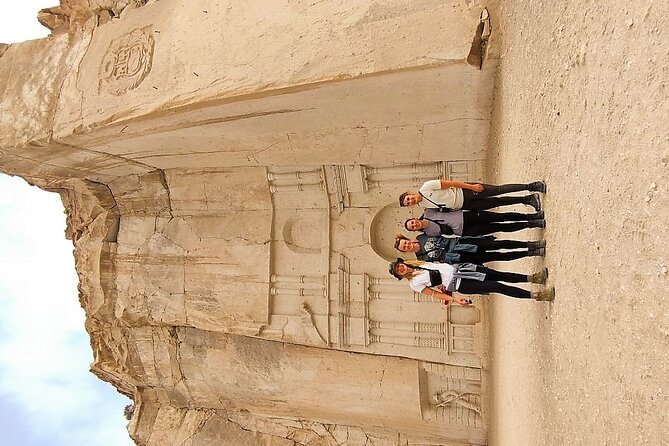
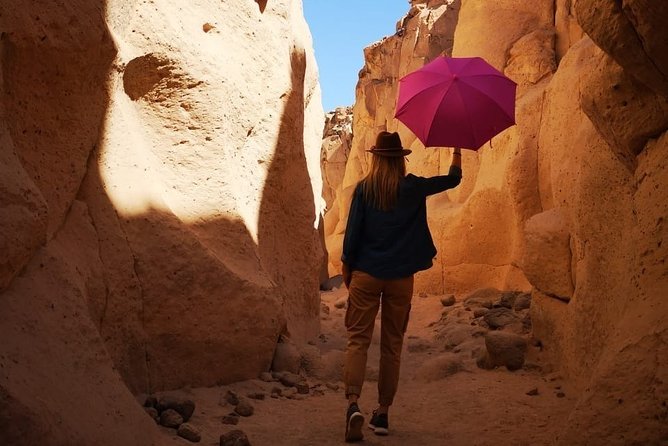
After the main quarry, you continue by vehicle to Culebrillas. The visit includes a walk of about 20 minutes through a narrow quarry environment with pink-colored walls.
Culebrillas feels different from the first stop. The main quarry focuses on extraction, carvings, and the ongoing work of shaping sillar. Culebrillas brings in ancient markings, sacred associations, and a more enclosed walk through the rock.
The petroglyphs are the main draw. They are connected with the life and beliefs of ancient people, and the guide explains their meaning and place within the site. Keep your eyes open, though. The markings can be faint, and getting close to them may be difficult when several groups gather at the end of the canyon.
The walk itself is part of the appeal. You move through the canyon, look up at the colored walls, and see how the rock forms a setting for the petroglyphs. The route is not long, but it gives you a change of pace after the larger quarry.
The exit is the section to take seriously. The walk back includes a steep climb over uneven ground. If you have trouble climbing steep slopes, this stop may be uncomfortable. The tour is described as suitable for most people, but that does not mean every part is easy for every participant.
Wear closed-toe shoes with a firm sole. Sandals and smooth shoes are poor choices for the uneven path. Take your time on the climb, especially if the group is moving quickly.
You also get the chance to build an apacheta. These are small stone arrangements with symbolic meaning, and the activity gives you a simple way to take part rather than only listen. It is a modest hands-on moment, but it helps distinguish Culebrillas from a standard photo stop.
How the timing affects the experience
On paper, the route is well balanced: 20 minutes at the volcano viewpoint, about an hour at the main quarry, and roughly 30 minutes at Culebrillas, including the walk and explanation. Add driving time, and four to five hours is a reasonable total.
In practice, the schedule can feel rushed. The first issue is pickup. Collecting people around the Plaza de Armas may use time that would be better spent at the quarry. The second issue is the number of things packed into the quarry visit. Sculptures, cliffs, explanations, photographs, and the traditional work all compete for a limited window.
The tour works best if you see it as an introduction, not an exhaustive study. You will get the basic story, several strong photo opportunities, and a sense of the physical setting. You will not have unlimited time to explore every quarry section or linger in the canyon.
I would prefer fewer pickup points and a longer main quarry visit. The Culebrillas walk is interesting, but the route there and back leaves little room for extending the hike. If you want a long canyon walk, this is not the right outing.
What the $17 price really includes
At $17 per person, this is an affordable way to reach sites outside central Arequipa. The price includes an air-conditioned vehicle, a professional guide, and admission to the quarry areas listed in the route.
That matters because independent transport to several outlying stops can take more planning. Here, one half-day package links the volcano viewpoint, the main sillar quarry, and Culebrillas.
The value is strongest if you want transportation and a basic explanation without paying for a private guide. A group limit of 18 keeps the outing from becoming a huge bus excursion, though you should still expect other people at the quarry and petroglyph area.
The price does not include soda, snacks, or the possible small fee for the additional sculpture section. Bring money for refreshments and do not count on every extra activity being part of the base cost.
For $17, I think the tour gives you a fair amount: three distinct stops, a guide, transport, and entry to the main sites. The trade-off is time. You save money, but you give up some freedom to set your own pace.
Who should book this half-day route
I would recommend it to you if you have limited time in Arequipa and want to understand the origin of the city’s pale stone buildings. It also suits photographers who want quarry cliffs, sculptures, and volcano views in one outing.
It is a good fit for anyone who prefers a structured visit. The guide supplies context, the vehicle handles the transfers, and the route is easy to follow.
Families and mixed-age groups may find the short format convenient, but the steep, uneven return from Culebrillas deserves a careful decision. Most people can participate, yet anyone who struggles with steep climbs should consider skipping this tour or confirming the walking conditions before booking.
I would not pick it if your main goal is to study stone cutting in depth. The tour introduces the traditional method, but the schedule may not allow a detailed demonstration. I also would not choose it if you dislike group pacing or want to spend a full hour or more hiking through the canyon.
Free cancellation is available when you cancel at least 24 hours before the start time. Changes or cancellations made later are not accepted for a refund, and the cutoff follows local Arequipa time.
My verdict: a useful first look at Arequipa’s stone
I like this tour because it makes Arequipa’s architecture easier to read. You see the volcanoes, visit the source of the sillar, examine carved stone, and walk through a canyon with ancient markings. That is a lot of context for $17.
The weak point is the clock. Pickup delays and short visits can leave you wishing for more time at the quarry and a longer walk at Culebrillas. The faint petroglyphs also require patience and a good position near the end of the canyon.
Book it if you want a budget-friendly introduction and can accept a brisk schedule. Skip it if you need an in-depth stone-cutting demonstration, a long hike, or complete control over your time. For most visitors with a free half-day, it is a practical way to get beyond the Plaza de Armas and see the material that gives Arequipa its name.
FAQ
Where does the Sillar Half Day Route begin?
The tour begins at Templo de San Agustín, JF26+VP3, Calle Sucre, Arequipa 04001, Peru.
Where does the tour end?
It returns to Templo de San Agustín and ends one block from the Plaza de Armas.
How long does the tour last?
The total duration is approximately four to five hours.
What time does the tour depart?
The listed tour times are 9:00 AM to 1:00 PM and 2:00 PM to 6:00 PM, Monday through Sunday.
What is included in the price?
The $17 price includes an air-conditioned vehicle, a professional guide, and admission to the listed quarry sites.
Are snacks and drinks included?
No. Soda, snacks, and other refreshments are not included.
Is the tour suitable for everyone?
Most people can participate, but Culebrillas includes uneven ground and a steep climb on the way out. Closed-toe shoes are advised, and the route may not suit anyone who struggles with steep slopes.
Just added in Arequipa
- Sillar Route★ 5.0 · 4 reviews
- Salinas Lagoon + Mini Volcano DE Lojen★ 5.0 · 9 reviews
- 3-Day Colca Canyon trek with Professional Guide★ 5.0 · 40 reviews
- Full Day Tour To The Salt Lake Salinas in Arequipa★ 4.5 · 34 reviews
- Walking City tour including the Monastery of Santa Catalina★ 5.0 · 6 reviews
- Trekking, Waterfalls and Thermal Baths★ 4.5 · 47 reviews
- Downhill Tour – Mountain Bike in Arequipa★ 3.5 · 5 reviews
- 2 Days 1 Night trekking Through Colca Canyon, Private room★ 5.0 · 16 reviews
Colca Canyon and Arequipa Tours, compared.
From Arequipa: Colca Canyon Full-Day Guided Tour with Meals
Read our review →
Tour to the Salinas Lagoon and National Reserve in Arequipa
Read our review →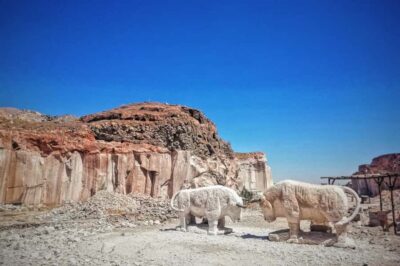
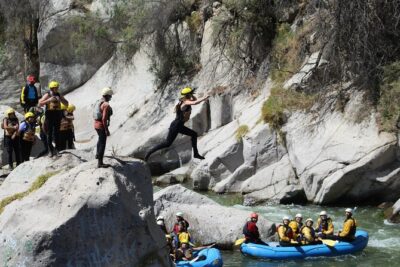
Rafting Arequipa – Chili River Canoeing – Cusipata Rafting Arequipa
Read our review →
Chili River White Water Rafting with Hotel Pickup
Read our review →
Browse the lists this tour appears in