Reviewed · SACRED VALLEY TOURS
From Ollantaytambo: Moray, Maras, and Chinchero Guided Tour
Three Andean sites, one very useful day. This guided outing from Ollantaytambo links Moray’s Inca terraces, Maras’s working salt pools, and Chinchero’s textile traditions without asking you to arrange separate rides. I like the clear mix of archaeology and living culture, and I like that round-trip transport keeps the day simple in the Sacred Valley. The main concern is uneven communication before departure, so you should confirm the meeting point and pickup time directly.
The guide can make or break a day built around ancient stones and technical details. Juan Carlos received especially strong praise for his English, patience, and willingness to take photos, while Yasmina was also credited with rescuing a difficult booking experience. Bring snacks, water, sun protection, and comfortable shoes, then expect a full day with extra entrance fees beyond the $80 tour price.
In This Review
- Key points at a glance
- Why this Sacred Valley day works from Ollantaytambo
- Moray’s giant Inca agricultural experiment
- Maras and its 2,000 working salt pools
- Chinchero’s yarn, color, and local skill
- The Sacred Valley views between stops
- Guides and the importance of clear communication
- What the $80 price really covers
- Who should book this experience
- Should you book the Moray, Maras, and Chinchero day?
- FAQ
- Where does the tour start and finish?
- What is included in the $80 price?
- Are entrance fees included?
- What languages does the guide speak?
- What should I bring?
- Is the tour suitable for wheelchair users?
Key points at a glance
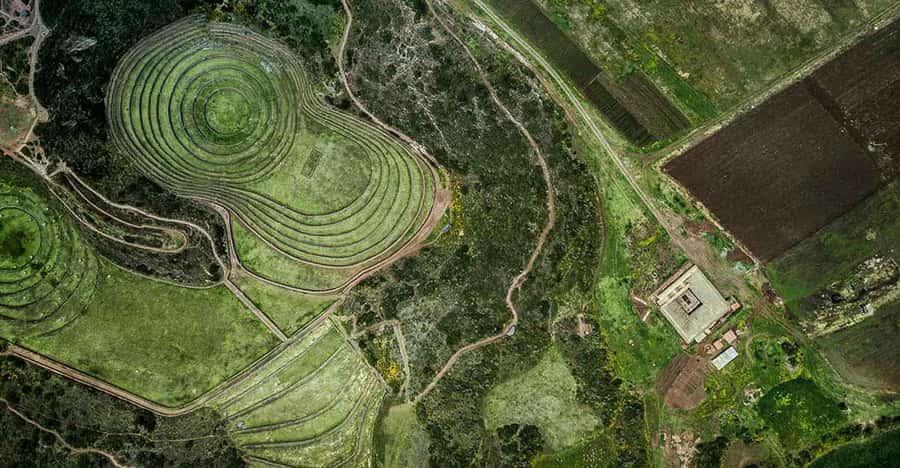
- Moray’s circular terraces show how the Incas used changes in temperature and elevation for farming experiments.
- Maras has about 2,000 salt pools, many still worked by local families using traditional methods.
- Chinchero’s textile center explains how wool and cotton become yarn, then receive color from natural pigments.
- The route begins and ends in Ollantaytambo, a useful setup if you are staying there before or after visiting Machu Picchu.
- Your guide matters here, especially at Moray, where the terraces are striking but their purpose is easier to grasp with explanation.
- Budget for admissions, including 70 soles for foreign visitors to the tourist ticket and 20 soles for Salineras.
Why this Sacred Valley day works from Ollantaytambo
Ollantaytambo is a practical base for seeing the western and central parts of the Cusco Region. From here, this day trip heads toward three places that feel quite different from one another: an Inca agricultural site, a working salt operation, and a town where textile skills remain part of local culture.
That variety is the best reason to choose this outing. You are not spending the whole day looking at similar ruins. Instead, you move from stone terraces to bright salt pans, then to demonstrations of spinning and dyeing.
The $80 price includes pickup at the designated meeting point, tourist transportation, and a professional guide. It does not include the required admissions, so the real cost depends on your nationality. Foreign visitors should allow 70 soles for the tourist ticket plus 20 soles for entry to the Salineras. Nationals pay 40 soles for the tourist ticket.
I see fair value here if you want convenience and explanation. Booking separate taxis or trying to link these three places yourself could take more planning, and a guide adds context you would not get from photographs alone. The value is less convincing if you already have private transport or prefer to set your own pace.
A full day does not always mean a late return. One recent departure reached lunch at about 13:30 and returned to Ollantaytambo around 15:30. Treat that as a useful guide rather than a fixed promise, since starting times depend on availability and road conditions.
More Sacred Valley trips:
- From Cusco: Sacred Valley & Maras Salt Mines Tour with Lunch
★ 4.8 · 2,227 reviews - From Cusco: Moray, Maras Salt Mines & Chinchero Weavers Tour
★ 4.8 · 1,925 reviews - 2-Day Tour: Sacred Valley and Machu Picchu by Train
★ 5.0 · 1,127 reviews
Moray’s giant Inca agricultural experiment
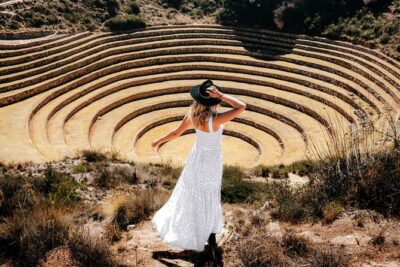
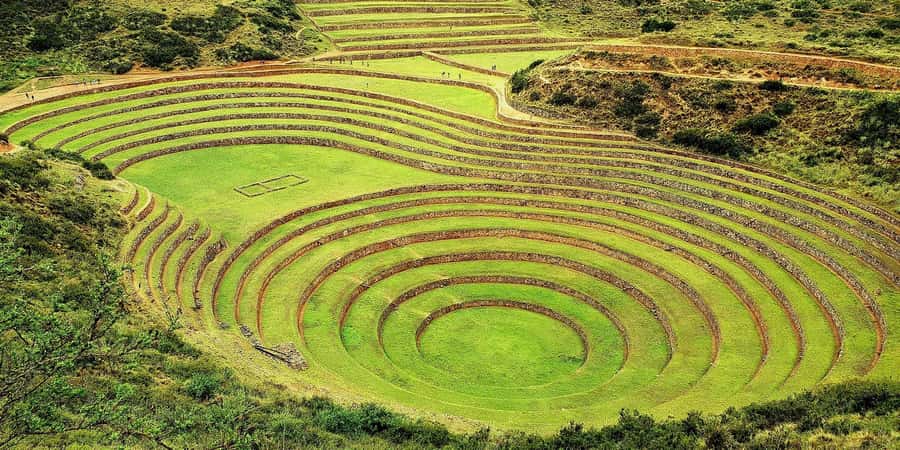
Moray is the intellectual highlight of the day. Its famous circular terraces sink into the earth like a huge green amphitheater, with broad rings stepping down toward the center.
The site is linked to Inca farming and the careful management of growing conditions. Each terrace sits at a different height, and the changes in exposure and temperature created several small growing environments. Your guide should explain how these microclimates and irrigation worked together.
That explanation matters. Without it, Moray can look like a dramatic set of stone circles and little more. With context, you begin to see the site as a carefully planned place connected to food production, water control, and the demands of a large highland state.
I like the way this stop rewards both the eye and the mind. The shape is easy to photograph, but the engineering is the lasting point. Look beyond the center and notice how the terraces form a measured sequence rather than a random depression.
The walking surface and steps mean this is not a suitable outing for wheelchair users. Comfortable shoes are a sensible choice even if you usually manage short archaeological visits in ordinary footwear. A sun hat, sunscreen, and water also matter because shade may be limited.
Moray is one of the places where an English or Spanish guide can add real value. Juan Carlos was praised for speaking clear English, answering questions, and helping with photos. That is useful here because the site’s main story is not just what you see, but why the Incas built it.
Maras and its 2,000 working salt pools
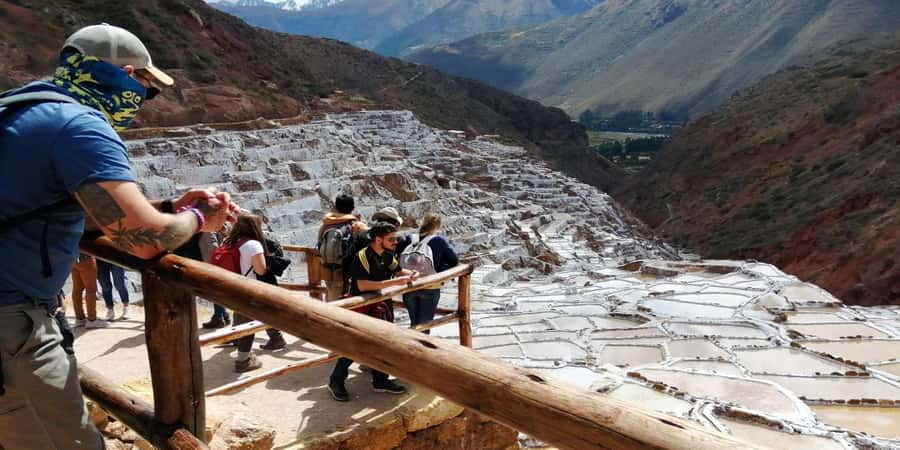
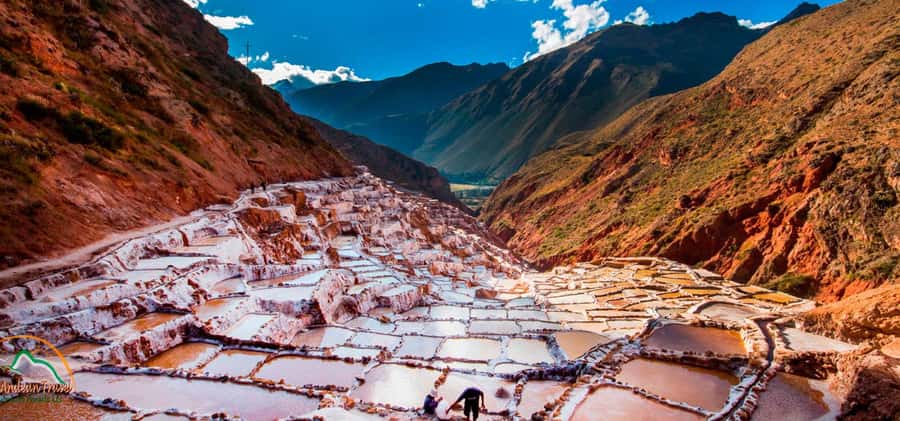
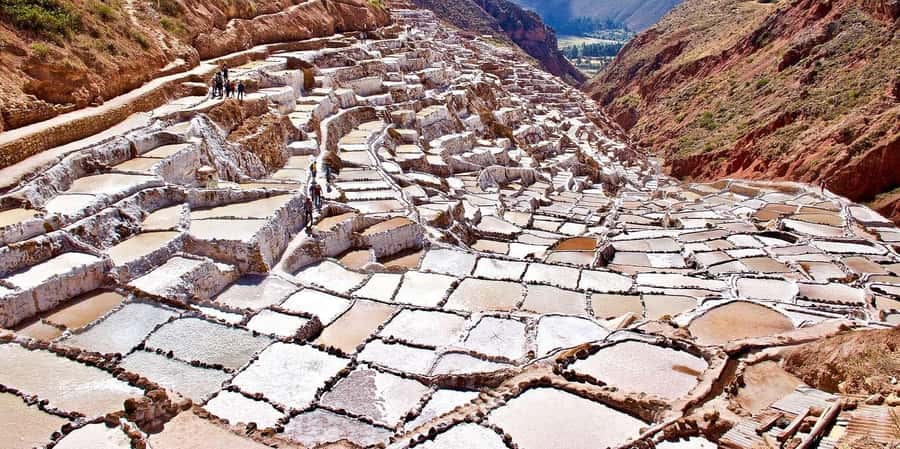
At Maras, the subject changes from farming to salt. Thousands of small pools cover the slope in pale bands, each one fed by salty spring water that is gradually reduced by sun and evaporation.
The pools are not simply an abandoned ancient site. Local families still use them to extract salt, giving the visit a direct connection to present-day work in the region. Your guide can explain how the water is directed into the pools and how the salt is collected through traditional methods.
That living connection makes Maras especially worthwhile. You are looking at an old system that still has an economic and family role, not only at a monument preserved for visitors. The small scale of the pools also helps you understand how much repeated labor is involved.
The view is one of the strongest photo opportunities on the route, but do not expect a long, leisurely wander through every pool. The salt works are spread across a slope, and access points can involve uneven ground. Keep your camera ready, but watch your footing too.
Entry to Salineras costs 20 soles and is separate from the tour. This is an easy charge to overlook when comparing prices, so include it before deciding what the day will cost you.
Maras can also be bright and exposed. Sunglasses are useful, though they were not specifically listed among the required items. The essentials provided for this outing are a hat, sunscreen, water, and shoes with a good grip.
Chinchero’s yarn, color, and local skill
Chinchero provides a welcome change of pace after the archaeological stops. Here, the focus is traditional textile making, from raw wool and cotton to yarn and finished color.
At the textile interpretation center, you can see how fibers are transformed into yarn and how natural pigments are used for dyeing. The demonstration gives you something concrete to watch: hands, tools, fiber, and color rather than only ruins and walls.
I find this kind of stop valuable because it connects the famous Andean textile tradition to actual processes. A finished woven item can look simple or decorative, but spinning and dyeing show the work behind it. Pay attention to the natural pigments and the preparation of the yarn, since those details are easy to miss in a market setting.
Chinchero also broadens the day’s story. Moray shows planned agriculture, Maras shows a working resource system, and Chinchero shows craft knowledge passed through local communities. Together, the stops present the Cusco Region as a place where old methods are not confined to museums.
You should understand the role of this visit before you go. It is an interpretation center and demonstration, not simply another major Inca ruin. If your main goal is monumental stonework, Moray will likely be more memorable. If you want to understand daily skills and local production, Chinchero earns its place.
A few more options to weigh up in Sacred Valley
- Private Professional Guide in Machu Picchu from Aguas Calientes
★ 5.0 · 165 reviews - Guided Tour in the Sacred Valley of the Incas – Cusco
★ 5.0 · 125 reviews - 4-Day Machu Picchu , Sacred Valley and Cusco-Private Guided Tour
★ 5.0 · 113 reviews - Machu Picchu: Group Guided Tour
★ 4.7 · 102 reviews
The Sacred Valley views between stops
The road connections are part of the appeal. As you move between Ollantaytambo, Moray, Maras, and Chinchero, you get broad views of the Sacred Valley and the highland surroundings.
The route gives you changing perspectives on cultivated fields, mountain slopes, and Andean settlements. These are not just empty stretches between attractions. They help you see why farming, water, salt, and textiles have mattered so much in this region.
Round-trip transport is the practical backbone of the experience. Pickup at the meeting point in Ollantaytambo removes the need to negotiate several one-way rides, and returning to the same town is handy if you have a hotel there or need to continue your plans from Ollantaytambo.
The tradeoff is control. Shared tourist transportation usually means you follow the group’s schedule, and the exact group size is not stated. If you want to linger at Moray, stop for a long meal, or skip Chinchero, this is not the most flexible format.
Lunch is not included. One recent day had lunch after the main stops at around 13:30, so carry a snack in case you get hungry before then. Do not assume every departure will follow that exact timing.
Guides and the importance of clear communication
The strongest part of this experience appears to be the guiding once the day is underway. Juan Carlos was singled out for strong English, useful explanations, questions answered without fuss, and taking plenty of photographs. Yasmina also received warm praise for her guiding.
Those details matter because the tour depends on interpretation. Moray needs an explanation of microclimates and irrigation. Maras needs context about family-owned pools and salt extraction. Chinchero needs a clear demonstration of fiber and dyeing. A good guide turns three stops into one connected story.
Before departure, communication appears less dependable. Some recent bookings involved uncertainty about the meeting point, timing, and return details. One person waited about 1.5 hours after the scheduled pickup and had difficulty reaching the provider, while another only heard from the guide shortly before the activity began.
I would not ignore that issue. Send a message before the day of the tour and confirm the exact meeting location, start time, transport details, and expected return. Save the provider’s contact information and arrive early. A WhatsApp message may be the most useful way to reach the guide, since that was how one guide made contact shortly before departure.
This is a reasonable precaution, not a reason to dismiss the whole outing. The guide quality can be excellent, but the office communication should be treated as a weak point.
What the $80 price really covers
At $80 per person, you are paying for a full day of transport and a guide rather than admission alone. That distinction is important. The tour price includes transportation, pickup at the Ollantaytambo meeting point, and professional guiding, but not the tourist ticket or Salineras entrance.
For a foreign visitor, add 90 soles in stated admissions: 70 soles for the tourist ticket and 20 soles for Salineras. Nationals have a lower tourist ticket cost of 40 soles, plus the same 20 soles Salineras fee.
I consider the price reasonable for someone who values a planned route and does not have a car or private driver. The day covers three separate areas, and the return to Ollantaytambo saves you from arranging a second transport plan.
The value drops if you only want one or two of the stops. It also drops if you need a private schedule, have mobility limitations, or dislike visits built around fixed group timing. There is no stated wheelchair suitability, and the uneven archaeological settings make this a poor match for wheelchair users.
Free cancellation up to 24 hours before departure and the option to reserve now and pay later give you some flexibility. Still, those booking features do not replace confirming the actual pickup details.
Who should book this experience
I would recommend this day to you if you are based in Ollantaytambo and want a broad introduction to several sides of the Sacred Valley. It suits first-time visitors who want history, working local traditions, scenic views, and transport in one package.
It is also a good fit if you want a guide to explain the technical side of Moray and the production methods at Maras and Chinchero. The strongest guides appear to add substantial value, especially for English-speaking visitors.
You should think twice if you need step-free access or a highly personal schedule. The tour is not suitable for wheelchair users, and the exact group size is not specified. Independent visitors with their own driver may prefer more time at each site.
Bring comfortable shoes, a sun hat, sunscreen, water, a camera, and snacks. The official list does not mention lunch as an inclusion, and the day can stretch until mid-afternoon, so a small food supply is sensible.
Should you book the Moray, Maras, and Chinchero day?
I would book it if your priority is efficient sightseeing from Ollantaytambo. Moray gives you the most striking archaeological setting, Maras adds a working local industry, and Chinchero brings in textile skills and natural dyeing. That is a thoughtful combination, not three interchangeable stops.
I would book with one condition: confirm the pickup arrangements yourself before the day begins. The experience can be excellent once you meet the guide, with Juan Carlos and Yasmina showing how much a strong guide adds, but the pre-tour communication needs extra care.
For $80 plus admission fees, this is a fair choice for a guided Sacred Valley day with transport. It is not the right pick for wheelchair users, private-tour seekers, or anyone unwilling to carry snacks and manage a fixed schedule.
FAQ
Where does the tour start and finish?
The tour includes pickup at a meeting point in Ollantaytambo and returns you to Ollantaytambo after visiting Moray, Maras, and Chinchero.
What is included in the $80 price?
The price includes pickup at the Ollantaytambo meeting point, tourist transportation, and a professional guide.
Are entrance fees included?
No. Foreign visitors pay 70 soles for the tourist ticket and 20 soles for entrance to Salineras. Nationals pay 40 soles for the tourist ticket, plus 20 soles for Salineras.
What languages does the guide speak?
Live guiding is available in English and Spanish.
What should I bring?
Bring comfortable shoes, a sun hat, a camera, sunscreen, water, and snacks. Lunch is not listed as included.
Is the tour suitable for wheelchair users?
No. The activity is not suitable for wheelchair users.
Just added in Sacred Valley
- Private Tour to Pisac Market and Pisac Ruins★ 5.0 · 4 reviews
- Sacred Valley Private Tour from Cusco, Guide and Driver only★ 5.0 · 4 reviews
- Sacred Valley of the Incas Tour★ 5.0 · 12 reviews
- Sacred Valley VIP Private Tour★ 5.0 · 32 reviews
- Private Tour Sacred Valley Vip Chinchero Ollantaytambo+lunch★ 5.0 · 10 reviews
- Private transfer Cusco to Ollantaytambo★ 5.0 · 7 reviews
- 6-Day Machu Picchu, Sacred Valley and Humantay Lake Tour★ 5.0 · 10 reviews
- Private Tour: 2-Day Exploration of the Sacred Valley and Machu Picchu★ 5.0 · 69 reviews
Sacred Valley Tours, compared.
From Cusco: Sacred Valley & Maras Salt Mines Tour with Lunch
Read our review →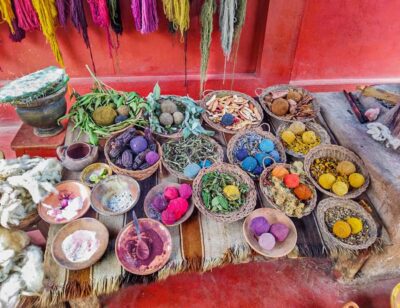
From Cusco: Moray, Maras Salt Mines & Chinchero Weavers Tour
Read our review →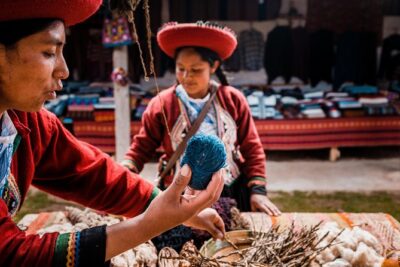
2-Day Tour: Sacred Valley and Machu Picchu by Train
Read our review →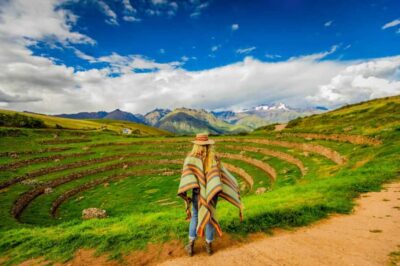
Sacred Valley, Pisac, Ollantaytambo, Salt Mines Moray
Read our review →
Chinchero,Moray & Salt Mines drop-off in Ollantaytambo
Read our review →
Sacred Valley and Maras Moray Tour with Full Day Buffet Lunch
Read our review →