Reviewed · SACRED VALLEY TOURS
Maras, Moray and Salt Mines Half-Day Tour Including Entrance Fee
Ancient salt, strange circles, one smart half-day. This tour links the Maras salt mines viewpoint with the remarkable Moray terraces near Cusco, giving you two major Sacred Valley sights without using up a full day. Hotel pickup, transport, a bilingual guide, and the Moray admission fee are included.
I like the small group limit of eight, which gives the guide room to answer questions and explain details without turning the visit into a march. I also like the personal touch reported with guides such as Alejandro, Able, Nico, Felix, and Milton, including one visit with a local salt-making family. The main drawback is the tight schedule: about one hour at each stop leaves little spare time if you want a slow visit or many photographs.
In This Review
- Key points at a glance
- Why this half-day pairing works
- The Maras salt mines viewpoint
- Moray and its giant circular terraces
- What the guide adds to the day
- Pickup, timing, and transport
- Is $89 a fair price?
- Who will enjoy this tour most?
- Small details that improve the experience
- Cancellation and booking flexibility
- Should you book the Maras and Moray tour?
- FAQ
- How much does the Maras, Moray and Salt Mines tour cost?
- How long does the tour last?
- What time does the tour start?
- Is hotel pickup and drop-off included?
- Are entrance fees included?
- How many people can join the tour?
- Is the tour offered in English?
Key points at a glance
- See two very different sites in four to five hours: Maras focuses on salt production and valley views, while Moray presents the Incas’ great circular terraces.
- The salt mines visit is mainly from a viewpoint: You get broad views and photo time, with the option of a more personal explanation from the guide.
- A maximum of eight people keeps the tour personal: This matters when you want to ask about archaeology, local families, or how the salt works.
- Moray admission is included: You do not need to budget a separate entrance fee for the ruins.
- Guides can add real depth: Alejandro shared family ties to the salt mines, while Able used his archaeology background to explain the sites.
- Pickup begins at 8:30 am: Hotel pickup and drop-off remove the need to find a public meeting point.
Why this half-day pairing works
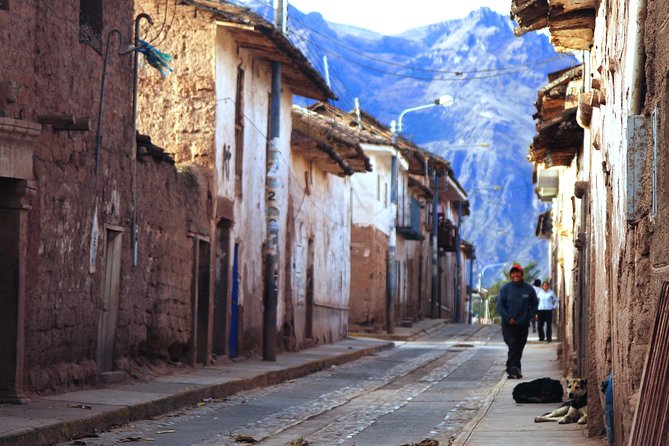
Maras and Moray are close enough to combine, but they feel entirely different. At Maras, you look across a broad hillside filled with small salt pools. At Moray, you stand beside immense circular terraces cut into the earth.
That contrast gives the outing a good rhythm. You begin with a place still connected to local work and family ownership, then move to one of the Sacred Valley’s most unusual archaeological sites. You are not spending four hours looking at similar ruins.
The tour lasts about four to five hours, with roughly one hour planned at each main stop. That makes it useful if you have only a short stay in Cusco or need the afternoon for another activity. It also suits you if you are fitting Sacred Valley sights around a longer Peru itinerary.
The tradeoff is simple: this is an efficient visit, not a slow study day. You will get an introduction, time for photos, and guided explanations, but you should not expect long independent walks or an open-ended schedule.
More Sacred Valley trips:
- From Cusco: Moray, Maras Salt Mines & Chinchero Weavers Tour
★ 4.8 · 1,925 reviews - 2-Day Tour: Sacred Valley and Machu Picchu by Train
★ 5.0 · 1,127 reviews - Cusco: Sacred Valley, Pisac, Ollantaytambo, Salt Mines Moray
★ 4.6 · 1,058 reviews
The Maras salt mines viewpoint
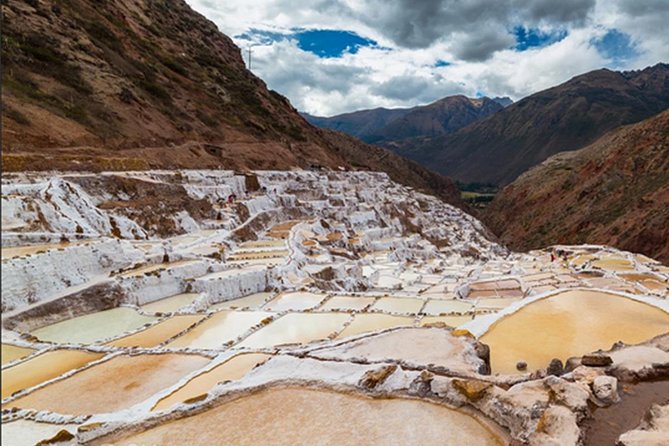
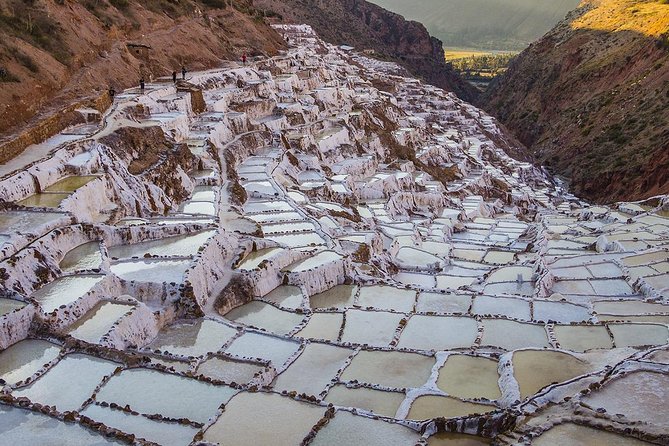
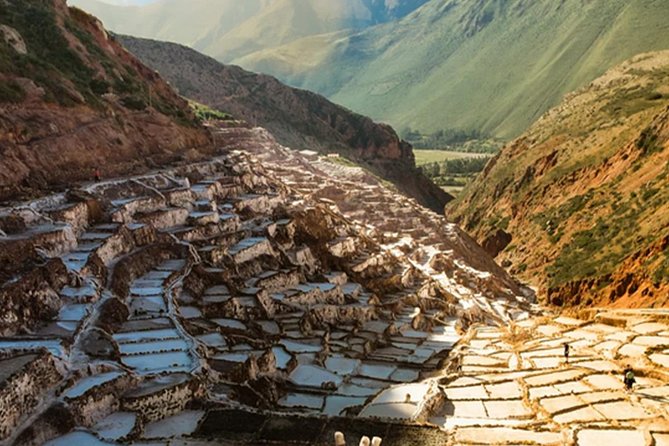
The first main stop is the lookout above the salt mines near Maras. From here, the hillside opens toward the Urubamba Valley, with rows of pale salt pools spreading across the slope.
The sight is unusual because the pools do not look like a conventional mine. They form a dense patchwork on the hillside, created by salty water that flows through an underground natural stream. As the water evaporates, salt remains behind. The process was used before the Inca period and continues as an important part of the area’s identity.
Your guide helps connect the view to the people who work the pools. One of the most memorable encounters associated with this tour involved a local family with a share in the salt mines. The family demonstrated how salt could be carved into small shapes, giving the visit a hands-on element that a standard photo stop would miss.
That experience may depend on the day and the guide, so I would treat it as a welcome possibility rather than a guaranteed feature. The confirmed stop is the salt mines viewpoint, along with a view of Maras town.
This distinction matters. If you are expecting to walk through every part of the salt complex, check the day’s exact arrangements with the provider. The stated visit centers on the lookout, not on a detailed industrial tour of every pool.
The one-hour stop should be enough for the main view, photographs, and an explanation of how the salt water is collected and evaporated. It may feel short if you want to linger over every angle, especially when the hillside is the kind of place that rewards patience.
I like having the guide here. Without context, the salt pools are striking but easy to treat as a quick photo stop. With an explanation of the underground stream, evaporation process, and family connections, you get a better sense of why this is a working cultural site rather than just a pretty view.
Moray and its giant circular terraces
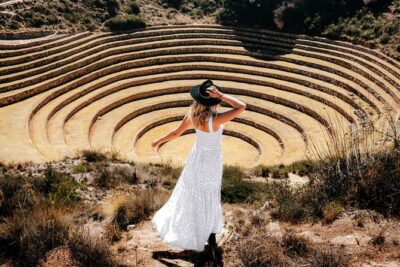
After Maras, the tour continues to Moray. The ruins consist of three large circular depressions, each formed by concentric terraces that descend into the ground.
The design looks almost theatrical from above. The curved lines make Moray immediately photogenic, but the site is more than an unusual shape. The terraces are thought to have served as an open-air crop laboratory, where the Incas could study how plants responded to different conditions.
The wording matters here. Moray is commonly explained as a place for agricultural experimentation, but the exact purpose is not proven in every detail. A good guide should explain the accepted theory without presenting every idea as settled fact.
This is where Able’s archaeology background could be especially useful. His explanations were praised for adding depth to the visit, and the small group gives you a better chance to ask how the terraces may have worked.
You have about an hour at Moray. That allows time to take in the largest views, listen to the explanation, and photograph the circular patterns from different points. It is enough for a focused first visit, though the schedule may feel brisk if you like to explore ruins at your own pace.
Moray also benefits from having been paired with Maras. After seeing the salt pools, you arrive at a site shaped by farming and climate. The two places show different ways people adapted to the natural setting: one uses salty water and evaporation, while the other reflects careful cultivation and observation.
What the guide adds to the day
The guide is the most important part of this experience. The sites are worth seeing on their own, but their meaning is not always obvious from a viewpoint or a terrace wall.
The supplied guide information lists professional Spanish and English service. Several individual guides received particularly strong praise for clear explanations, storytelling, punctuality, and professional conduct. Alejandro was linked to a personal family history connected with the salt mines. Able brought an archaeology background. Nico was praised for his stories and was used again for another Peru excursion.
Those details suggest a useful strength: the tour can offer more than a basic transfer between attractions. You may get local stories, archaeological interpretation, and help understanding how the salt mines fit into present-day community life.
Still, guide quality can vary from one departure to another. The named guides are not guaranteed in the information provided. If a particular guide matters to you, ask CrossoverPeru Tours before booking.
A group capped at eight is another real advantage. You can hear the explanation more easily, ask follow-up questions, and avoid the impersonal feel of a large coach. A small group also makes it easier for the guide to adjust the pace a little, although the overall four to five-hour framework remains fixed.
More things to do in Cusco:
- Classic Inca Trail Trek 4D/3N to Machu Picchu (Group Service)
★ 5.0 · 8,653 reviews - Cusco: Rainbow Mountain and Red Valley Day Trip with Meals
★ 4.9 · 4,893 reviews - Machu Picchu: 4-Day Inca Trail Trek with Panoramic Train Ride
★ 5.0 · 4,568 reviews - Salkantay Classic Trek 5 Days from Cusco
★ 5.0 · 4,062 reviews
Pickup, timing, and transport
The tour starts at 8:30 am and includes hotel pickup and drop-off. That is valuable in Cusco, where finding a meeting point can take extra planning, especially if you are unfamiliar with the city.
You should provide accurate hotel details at booking and be ready around the stated start time. The experience is offered with pickup, but the information does not specify a separate pickup window for each hotel.
Transport is included, so you do not need to arrange a separate vehicle between Cusco, Maras, and Moray. The short duration also makes this a practical choice before an afternoon commitment, although I would leave a buffer because the advertised duration is approximate.
The tour is offered in English, with a Spanish-English professional guide listed among the inclusions. It is also near public transportation, though that is less important if you use the included pickup and drop-off.
Most people can participate according to the supplied information. No special accessibility details are provided, so you should ask the operator directly if you have mobility needs or require specific assistance.
Is $89 a fair price?
At $89 per person, the tour is not the cheapest way to see Maras and Moray. Its value comes from what is bundled into the price: hotel pickup and return, transport, a bilingual guide, a small group of no more than eight, and entrance fees.
The Moray admission fee is included. The Maras stop includes the viewpoint and the visit details provided, with no separate admission fee listed for that part. Food and drinks are not included, and the price does not cover a hotel night in Cusco, which is simply irrelevant unless you are comparing it with a package.
I think the price is reasonable if you value convenience and interpretation. Arranging transport, finding the sites, and hiring a guide separately could take more time and may not provide the same small-group setting. The personal salt-making demonstration, when available, also adds something beyond a basic sightseeing transfer.
The value is weaker if you already have private transport and prefer to explore alone. In that case, you are paying mainly for the guide and the organized timing. You should also remember that this is a half-day introduction, not a full-day private tour with flexible stops.
Who will enjoy this tour most?
I would recommend it to you if you want two major Sacred Valley sights in a compact morning. It suits first-time visitors to the area, people with limited time in Cusco, and anyone who prefers having transport and admission arrangements handled in advance.
It is also a good fit if you care about context. The salt mines are easy to photograph without understanding how the pools are formed or how local families are connected to them. Moray can look like a set of giant circles unless someone explains the agricultural theory and its limits.
The tour may suit families and mixed-age groups because the stops are short and varied. The information says most people can participate, but it does not provide detailed accessibility notes. Ask before booking if stairs, uneven surfaces, or walking distances could be an issue for you.
You may prefer a longer or private outing if photography is your main aim, if you dislike fixed schedules, or if you want extended time in the Maras salt pools. The one-hour stops are practical, but they are not leisurely.
Small details that improve the experience
Keep your morning expectations realistic. This is a focused sightseeing trip, so use the travel time for the guide’s explanations and save your energy for the two stops.
Bring a way to protect yourself from the elements, though the supplied details do not list specific weather conditions or equipment. Comfortable clothing and footwear are sensible for any archaeological visit, but the operator has not provided a detailed packing list.
Plan to purchase food and drinks separately, since neither is included. The tour is short, so you may simply eat before pickup or arrange something for afterward.
Ask about the salt family visit if that personal demonstration is important to you. It was a memorable part of one outing, but the formal tour details confirm the lookout and Maras town view rather than promising that encounter on every departure.
Finally, use the guide. Ask about the salt water, the families who hold shares in the mines, and the theories surrounding Moray. The strongest part of this experience is not just seeing two unusual places. It is getting enough explanation to understand why they matter.
Cancellation and booking flexibility
You can cancel for a full refund if you do so at least 24 hours before the experience begins. Cancellations made less than 24 hours before the start time are not refunded, and changes inside that same period are not accepted.
Confirmation is provided at booking. Since pickup is offered and the tour starts at 8:30 am, check that your hotel information is correct and keep the confirmation available on your phone.
Should you book the Maras and Moray tour?
Book this tour if you want an efficient morning, a small group, included transport, and a guide who can add local and archaeological context. The strongest reasons are the group size, the personal guide service, and the chance of learning directly from a family connected with the salt mines.
Skip it if you want a slow, independent visit or a guaranteed extended walk through the salt pools. The confirmed plan is a viewpoint at Maras and about one hour at Moray, so the experience favors coverage and convenience over freedom.
For most first-time visitors with only half a day available, $89 is a fair price for two distinctive sites and a well-supported visit. Ask about the assigned guide and the salt family demonstration before booking, then use the short schedule wisely.
FAQ
How much does the Maras, Moray and Salt Mines tour cost?
The tour costs $89 per person.
How long does the tour last?
The experience lasts approximately four to five hours.
What time does the tour start?
The tour starts at 8:30 am.
Is hotel pickup and drop-off included?
Yes. Hotel pickup and drop-off are included, so you do not need to find a separate meeting point.
Are entrance fees included?
Yes. Entrance fees are included, including admission to Moray. The Maras portion includes the salt mines viewpoint and a view of Maras town, with no admission fee listed for that stop.
How many people can join the tour?
The group has a maximum of eight people.
Is the tour offered in English?
Yes. The experience is offered in English and includes a Spanish-English professional guide.
Just added in Cusco
- Cusco Private Transportation for 2026★ 5.0 · 4 reviews
- Private Transfer from Airport to Hotel in the City of Cusco★ 4.0 · 5 reviews
- Best Cusco walking tour: dinner street food tasting★ 4.5 · 11 reviews
- Private Tour to Pisac Market and Pisac Ruins★ 5.0 · 4 reviews
- Machu Picchu Day Trip With Panoramic Train from Cusco★ 5.0 · 10 reviews
- Sacred Valley of the Incas Tour★ 5.0 · 12 reviews
- Private Tour of the Mountain of Colours by Quad★ 5.0 · 7 reviews
- Sacred Valley Private Tour from Cusco, Guide and Driver only★ 5.0 · 4 reviews
Sacred Valley Tours, compared.
From Cusco: Sacred Valley & Maras Salt Mines Tour with Lunch
Read our review →
From Cusco: Moray, Maras Salt Mines & Chinchero Weavers Tour
Read our review →
2-Day Tour: Sacred Valley and Machu Picchu by Train
Read our review →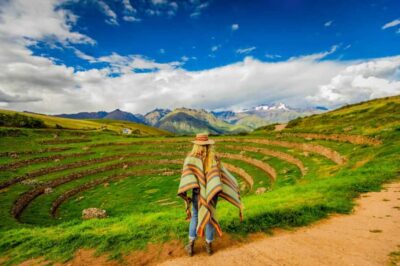
Sacred Valley, Pisac, Ollantaytambo, Salt Mines Moray
Read our review →
Chinchero,Moray & Salt Mines drop-off in Ollantaytambo
Read our review →
Sacred Valley and Maras Moray Tour with Full Day Buffet Lunch
Read our review →